
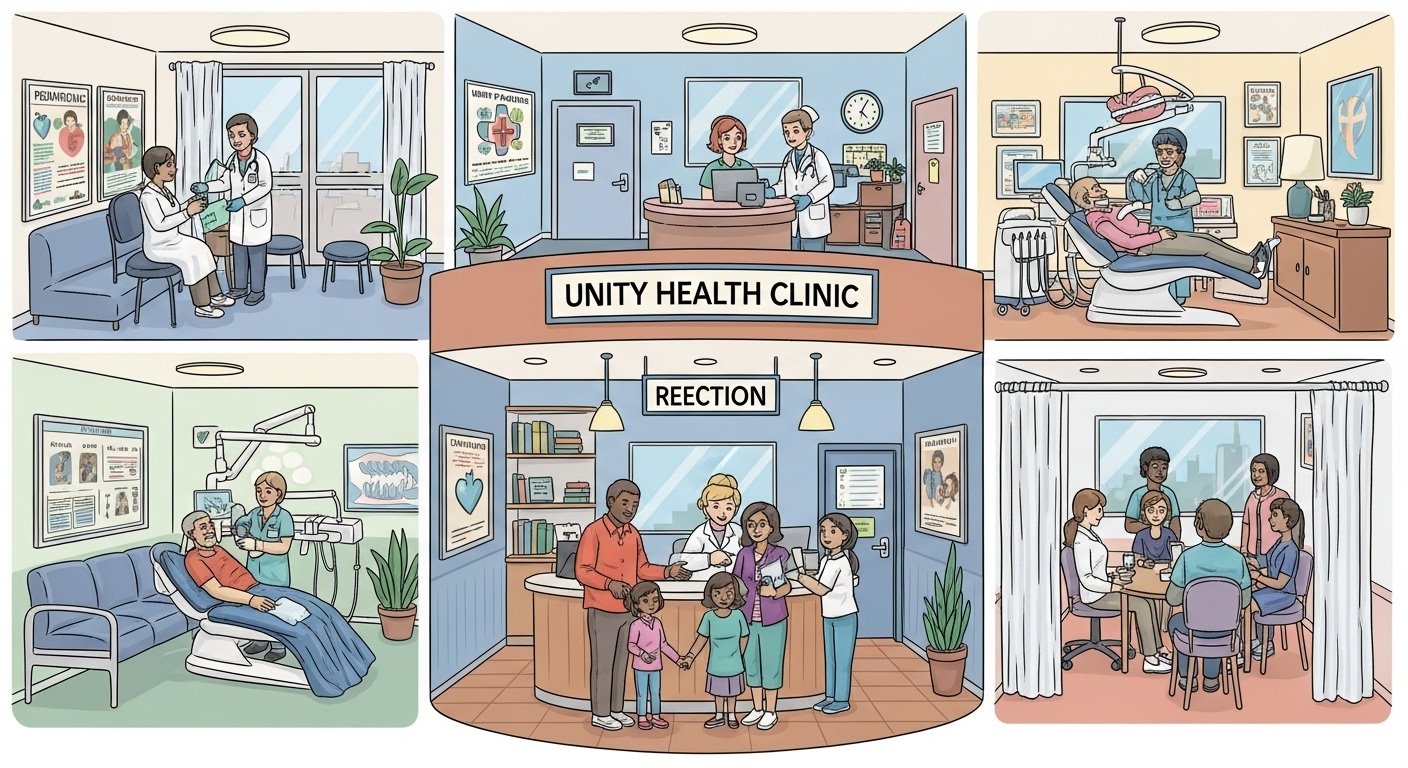

Community health clinics — including Federally Qualified Health Centers (FQHCs) and free clinics — are healthcare facilities specifically designed to serve underserved populations: the uninsured, underinsured, low-income individuals and families, farmworkers, homeless persons, and others who face barriers to mainstream healthcare access. They are among the most important components of America’s healthcare safety net, providing comprehensive primary care services regardless of a patient’s ability to pay. This guide explains what community health clinics are, what they offer, and how to access them.
Federally Qualified Health Centers (FQHCs)
FQHCs are community-based healthcare providers that receive federal funding through the Health Resources and Services Administration (HRSA) to provide comprehensive primary care to underserved populations. They must offer primary care, dental, behavioral health, and pharmacy services, and charge patients on a sliding fee scale based on income — meaning you pay only what you can afford. As of 2024, over 1,400 FQHCs operate more than 14,000 service sites across the US.
Services Typically Offered
- Primary care for all ages (family medicine, internal medicine, pediatrics)
- Dental services
- Behavioral and mental health services
- Pharmacy services
- WIC and nutrition services
- Health education
- Transportation assistance
- Translation and interpretation services
- Case management and social work
Free Clinics
Free clinics are nonprofit organizations that provide medical, dental, and mental health care at no charge, primarily through volunteer healthcare professionals. They serve as critical safety nets in communities where FQHCs may not be available or have long wait lists. Find your nearest free clinic through the National Association of Free and Charitable Clinics (nafcclinics.org).
Conclusion
Community health clinics ensure that quality healthcare is available to everyone — regardless of income, insurance status, or immigration status. If you or someone you know needs healthcare but cannot afford standard clinic costs, a community health clinic or FQHC can provide comprehensive, dignified care with fees adjusted to what you can actually pay. Find your nearest FQHC at findahealthcenter.hrsa.gov.
FAQs – Community Health Clinics
Q1. Who qualifies to use a community health clinic?
A: FQHCs serve everyone regardless of ability to pay, insurance status, or immigration status. No one is turned away. Sliding fee scale charges are based on family income and size.
Q2. Are community health clinics good quality care?
A: Yes. FQHCs are required to meet rigorous federal quality standards and undergo regular performance reviews. Studies consistently show that FQHC patients receive care comparable in quality to private-practice patients.
Q3. Do community health clinics accept Medicaid and Medicare?
A: Yes. FQHCs accept Medicaid, Medicare, and most insurance plans. They also serve uninsured patients on a sliding scale.
Q4. Are there long waits at community health clinics?
A: Wait times vary. Some FQHCs have high demand and appointment waits of several weeks for new patients. Many offer same-day sick visits. Persistence in getting established as a new patient is worthwhile given the quality and affordability of care.
Q5. Do community health clinics offer specialty care?
A: Many FQHCs coordinate specialty care for their patients through partnerships with hospitals and specialty clinics, sometimes offering specialty services on-site on a rotating basis.


